
Walkie Stacker: A Practical Guide for Tight Warehouses
Learn how a walkie stacker lifts and stacks pallets in tight aisles, what drives walkie stacker price, and how to choose the right model for your warehouse.
A walkie stacker is a pedestrian-operated lift truck that raises, lowers and moves palletized loads where a full-size forklift is impractical. It combines the compact footprint of a pallet jack with a mast that lifts loads to rack height, making it a practical choice for warehouses, retail backrooms and congested production areas. If you are comparing a walkie stacker forklift against a rider truck or a basic pallet jack, the decision usually comes down to aisle geometry, load profile and how often the machine needs to place a pallet above floor level.
What a walkie stacker does — and what it does not
A walkie stacker is defined by three things: a walk-behind operator position, a vertical mast, and forks that can enter a pallet. The operator walks with the machine, steering it by a tiller arm. The mast does the lifting, so the unit can place a pallet on a rack beam, stack one pallet on another, or feed a trailer. It is not a general-purpose yard truck. Traction, gradeability and travel speed are limited by design, and it should not be treated as a substitute for a diesel forklift on rough ground or long hauls.
Typical duties include:
- Stacking and de-stacking pallets at low to medium lift heights
- Replenishing pick faces at ergonomic working height
- Loading and unloading trailers from the dock edge
- Moving materials through narrow aisles and crowded retail floors
- Feeding production cells where a rider truck would be too large
Walkie stacker vs forklift: when the walk-behind wins
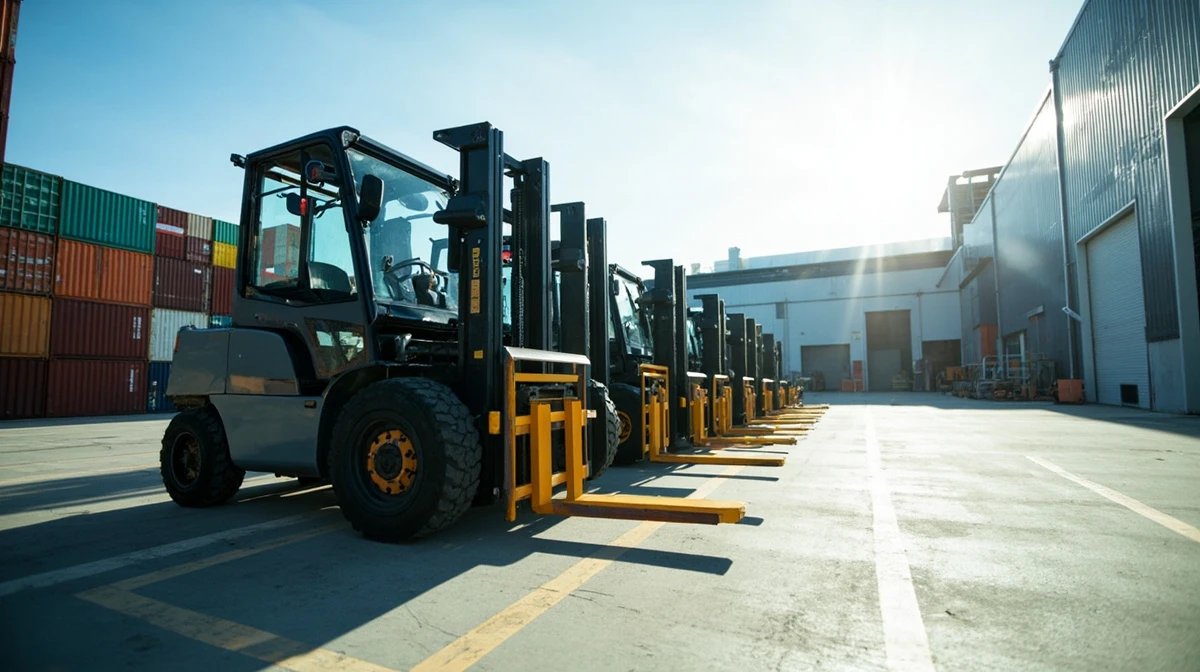
The core advantage is space. A walkie stacker forklift needs less aisle width than a counterbalance forklift because the operator stands beside or behind the machine rather than inside a cab. That makes it viable in older buildings where racking was installed before modern aisle standards. It is also easier to train an operator on, and it costs less to run than a diesel or LPG truck.
The trade-off is throughput. Travel speed is lower, the operator is exposed to weather, and lift heights are generally shorter than a reach truck. For high-turnover, multi-shift operations, a rider truck or reach truck will usually be more productive. For low-to-medium volume, a walkie stacker is often the more sensible allocation of capital.
| Factor | Walkie stacker | Counterbalance forklift |
|---|---|---|
| Operator position | Walk-behind | Seated or standing rider |
| Aisle requirement | Narrow; suits tight racking | Wider; needs turning clearance |
| Typical power | Electric (battery) | Diesel, LPG or lithium electric |
| Best for | Stacking, replenishment, trailer loading | High-volume travel, yard work, heavy loads |
| Relative cost | Lower acquisition and running cost | Higher acquisition and fuel cost |
For operations that need both, the sensible split is a walkie stacker inside the building and a diesel or electric forklift for the yard. Impetus supplies both sides of that split — see the forklift and equipment catalog for counterbalance and warehouse options.
How to specify the right walkie stacker
Load capacity and residual capacity
Start with the heaviest pallet you actually move, then add a margin. More importantly, confirm the machine can still lift that load at your working height. Residual capacity falls as lift height increases, so a stacker rated for a given load at ground level may not handle the same load at full mast extension. Ask for the capacity chart, not just the headline number.
Lift height and collapsed height
Measure your highest rack beam and your lowest overhead obstruction. The difference defines the usable lift range. Also check the collapsed mast height if the machine must pass through a doorway or under a mezzanine.
Aisle width and fork dimensions
Measure the narrowest aisle and the widest pallet. Fork length, width and spread must match your pallet entry. A stacker that fits the aisle but not the pallet is a costly mistake.
Power and duty cycle
Most walkie stackers are battery-electric, which suits indoor use and avoids exhaust emissions. Match battery capacity to shift length and charging windows. For heavy indoor duty, a lithium-electric counterbalance truck such as the FB series may be a better fit than a pedestrian unit.
What drives walkie stacker price
Walkie stacker price varies with capacity, lift height, mast type, battery technology and build quality. Two machines with the same headline capacity can differ significantly in frame thickness, hydraulic components and after-sales support. When comparing a walkie stacker for sale, look beyond the sticker:
- Capacity and lift height — higher ratings and taller masts cost more
- Battery and charger — included or extra, lead-acid or lithium
- Mast configuration — single-stage, two-stage or three-stage
- Build and serviceability — parts availability and local support
- Freight and duties — especially for cross-border purchases
For a walkie stacker forklift for sale, request a quotation that itemizes the machine, battery, charger and spare-parts kit. That makes comparison honest and avoids surprises at commissioning.
Safe operation and maintenance basics
Walkie stackers are simple machines, but they still require discipline. Keep the operator clear of the mast and load, travel with the load low, and never exceed the capacity chart. On ramps, the load should face uphill. Daily checks should cover hydraulic fluid, battery charge, fork condition and emergency reverse. Schedule hydraulic and brake inspection at the intervals in the manual, and keep a spare set of forks on hand if the machine runs multiple shifts.
Most walkie stacker failures we see are not structural — they are hydraulic leaks and battery neglect. A simple daily checklist prevents both.
If your operation also runs larger trucks, the same maintenance discipline applies. Impetus publishes practical guidance in its news and guides section.
FAQ
What is the difference between a walkie stacker and a pallet jack?
A pallet jack lifts a load a few centimetres off the floor for horizontal transport. A walkie stacker adds a mast, so it can raise a pallet to rack height and stack loads. The stacker is the right tool when the job involves vertical placement, not just movement.
Can a walkie stacker replace a forklift?
In some operations, yes — particularly where aisles are narrow, volumes are moderate and lift heights are within the stacker's range. It cannot replace a forklift for yard work, rough terrain or high-throughput travel. Many warehouses run both.
How much does a walkie stacker cost?
Walkie stacker price depends on capacity, lift height, battery type and included accessories. Entry-level units sit at the lower end; higher-capacity models with lithium batteries and taller masts cost more. Request a detailed quote so you can compare like for like.
Ready to specify a walkie stacker for your warehouse? Impetus has over 20 years of export experience and supplies forklifts, warehouse equipment and attachments to more than 150 countries. Send your load profile, aisle dimensions and lift height to our team and we will recommend the right configuration. Contact Impetus for a quote or browse the full product categories to see the complete range.