
Telehandler Attachments: The Complete Buyer's Guide
Telehandler attachments explained: how to match forks, buckets and jibs to your boom, avoid derating mistakes, and plan telehandler price before you buy.
A telehandler is a telescopic handler: a rough-terrain machine with a boom that extends and retracts, built to lift, carry and place loads that a standard forklift cannot reach. On most sites the machine itself is only half the story. The attachment bolted to the boom carriage decides what the telehandler can actually do — and, just as importantly, how much it can still lift once that attachment is fitted. This guide covers the attachment families used on construction telehandlers, how each one changes capacity and reach, how to specify correctly, and what drives telehandler price when you are comparing telehandlers for sale.
What a Telehandler Does That a Forklift Cannot
A counterbalance forklift lifts vertically and depends on a short load centre. A telehandler adds forward reach: the boom telescopes out, so the carriage can be positioned over a trench, past a wall, or up to a second-floor slab. That single capability is why telehandlers appear on almost every mid-size building site, and why the attachment range is so much wider than a forklift's.
Three characteristics define every telehandler task:
- Capacity at reach, not at the carriage. Rated capacity is quoted at a specific load centre and boom position. Extend the boom and the number falls.
- Attachment weight counts against you. A heavy bucket or jib consumes part of the rated capacity before you pick up any load.
- Stability is a function of the whole machine. Tyre size, wheelbase, frame weight and outriggers all set the limit, not the attachment alone.
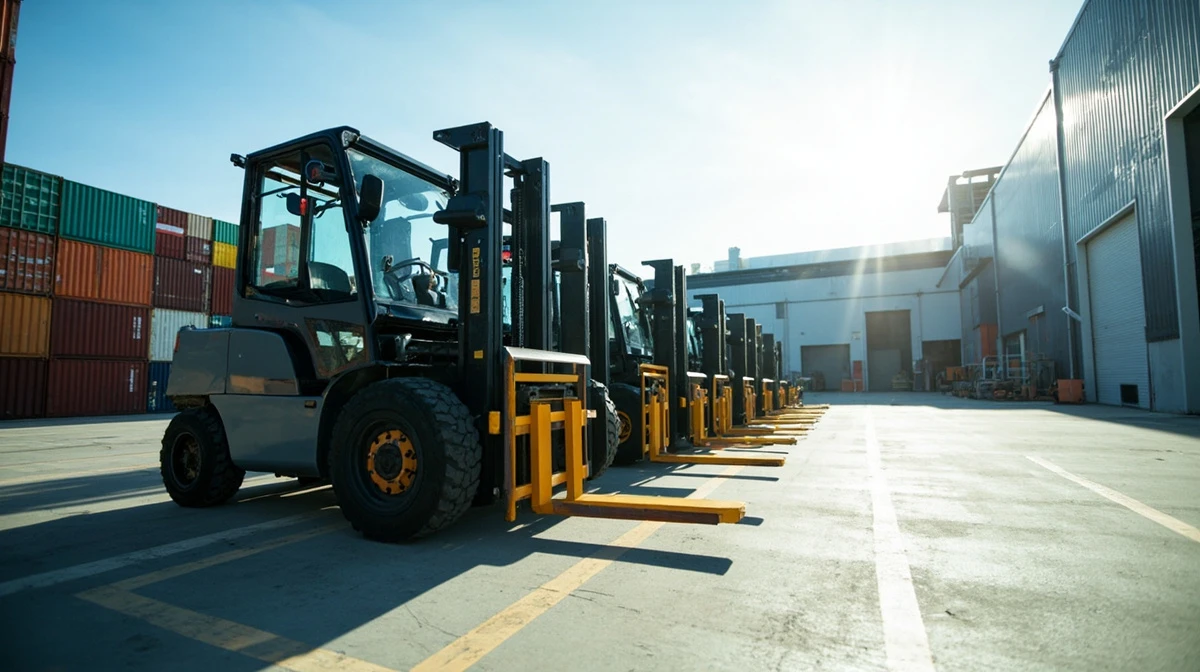
If your work is pure vertical handling on hard, level ground with no forward reach required, a diesel forklift such as the FD30 or FD50 is the more economical tool. The telehandler earns its place when reach, rough ground or attachment swapping is part of the daily routine.
The Main Telehandler Attachment Families
Attachments mount to the boom head carriage, usually on a quick-coupler, and are grouped by the job they perform.
Material handling
- Pallet forks — the default attachment. Fixed or side-shifting, with tines sized to the load. This is the configuration most construction telehandlers are ordered in.
- Man baskets / work platforms — raise personnel for inspection and light work. These require a machine rated and configured for personnel lifting, with the correct controls and levelling, and are governed by local rules on fall protection and operator certification.
Earthmoving and bulk
- General-purpose buckets — for loose aggregate, sand and spoil.
- Grab buckets and grapple buckets — for debris, brush and irregular material that will not sit in an open bucket.
Lifting and placement
- Truss booms and jibs — a hook on an extension, used to lift suspended loads such as pipe, steel and precast units. These change the load geometry completely and must be matched to the machine's load chart.
- Concrete skips and hoppers — place concrete where a chute cannot reach.
Specialist
- Bale spikes and bale handlers — the agricultural mainstay.
- Sweepers and brooms — site and yard cleanup.
- Winches and rotators — for controlled positioning of awkward loads.
Whatever the family, the attachment must be rated for the machine's hydraulic flow, carriage pin pattern and rated capacity. A coupler that fits is not proof that the combination is safe.
How Attachments Change Capacity and Reach
This is the part buyers most often underestimate. The load chart printed for the bare carriage does not apply once you bolt on a bucket. Two effects combine:
- The attachment's own mass is deducted from the rated capacity at every boom position.
- A bucket or jib moves the load centre further forward, which reduces the allowable load even before the boom extends.
The practical rule: specify the machine from the heaviest attachment-plus-load combination you will actually run at maximum reach, not from the headline capacity figure. When a specification sheet does not state a figure for your exact configuration, treat the design principle as the guide — the further forward and the further out the load sits, the less the machine will lift — and confirm the numbers with the manufacturer before committing.
Telehandler vs Forklift: Which Machine Fits the Job
The comparison below is a decision aid, not a specification table. It describes how the two machine types behave, so you can pick the right category before comparing individual models.
| Factor | Telehandler (telescopic handler) | Counterbalance forklift |
|---|---|---|
| Lift motion | Vertical plus forward telescopic reach | Vertical only |
| Typical ground | Rough, uneven, unpaved sites | Warehouse floors, yards, paved surfaces |
| Attachment range | Very wide — forks, buckets, jibs, skips, baskets | Narrow — forks, clamps, specialised handling heads |
| Capacity behaviour | Falls sharply as boom extends | Falls with load centre, but no reach variable |
| Best suited to | Construction, agriculture, outdoor placement | Indoor and outdoor unit-load handling |
| Running cost profile | Higher purchase and maintenance cost | Lower cost per hour for pure vertical handling |
Many operations run both. A site might use a telehandler for structural steel and concrete placement while a lithium electric forklift such as the FB30 or FB50 handles palletised materials in the yard. Impetus builds both categories, so the two can be specified together from one supplier — see the forklift & equipment catalog for the full range.
What Drives Telehandler Price
Telehandler price is not a single number; it is the sum of a configuration. The variables that move it most are:
- Maximum lift height and capacity class — a higher, stronger boom costs more across the whole machine.
- Drivetrain and tyres — 4WD, differential lock and rough-terrain tyres add cost but are essential on soft ground.
- Attachment package — a quick-coupler plus two or three attachments is often quoted as a bundle; buying them with the machine is usually cheaper than adding them later.
- Cab and controls — enclosed cabs, joystick control and load-moment indicators raise the specification.
- Compliance and documentation — emissions configuration, certification and spare-parts support for your market.
When you compare telehandlers for sale, compare them at the same attachment specification. A low headline price for a bare machine can invert once you add the coupler, forks, bucket and jib you actually need. Ask each supplier for a configured quotation, not a base price.
Specifying and Maintaining Telehandler Attachments
A short checklist before you order:
- List every task the machine will perform in a normal month, and the heaviest load for each.
- For each task, note the maximum height and the maximum forward reach required.
- Identify the attachment for each task and its mass.
- Check the load chart for attachment-plus-load at that height and reach.
- Confirm the coupler type, pin pattern and hydraulic flow match.
- Confirm operator training and any local certification requirements for the attachment, especially for personnel platforms.
On the maintenance side, attachments are where small faults become incidents. Inspect coupler pins and locking mechanisms before every shift, check hydraulic quick-couplers for leaks and contamination, and keep fork tines and bucket cutting edges free of cracks and deformation. Record attachment serial numbers against the machine so a damaged item is not returned to service by mistake.
FAQ
Can any telehandler use any attachment?
No. The attachment must match the machine's carriage or coupler pattern, hydraulic flow and rated capacity, and the combined attachment-plus-load weight must fall inside the load chart at the required height and reach. A physical fit does not by itself make a combination safe.
Does fitting a bucket reduce how much a telehandler can lift?
Yes. The bucket's own mass is deducted from the rated capacity, and because the load sits further forward, the allowable load at a given reach is lower than with bare forks. Always work from the load chart for the specific attachment, not the base machine figure.
Is a telehandler or a forklift cheaper to run?
For pure vertical handling on hard, level ground, a counterbalance forklift is normally cheaper to buy and to run. A telehandler costs more but replaces several machines on a site because it reaches forward, works on rough ground and accepts a wide range of attachments.
Next Step
If you are specifying a telehandler and its attachment package, the fastest route to an accurate number is a configured quotation. Send us your lift height, maximum reach, heaviest load and the tasks you need to cover, and the Impetus team will match the machine and attachments to the job. Browse the full range at our product catalog, review application notes in our news and guides, or contact Impetus for a quote.