
Stand Up Forklift: A Warehouse Buyer's Guide to Electric Reach Trucks
Stand up forklift guide for warehouse buyers: how stand up electric forklifts work, aisle width, capacity, stand up forklift cost and how to spec the right truck.
A stand up forklift is a battery-powered truck operated from a standing compartment, usually on three wheels, and it is the default choice when aisle space, not load weight, is the constraint in your building. If you are comparing a stand up electric forklift against a sit-down rider for a racking retrofit or a new distribution centre, the decision usually comes down to four numbers: aisle width, lift height, load capacity and battery strategy. This guide walks through how stand-up reach trucks actually work, where they earn their keep, and what drives stand up forklift cost.
What Is a Stand Up Forklift and How Does It Differ From a Sit-Down Rider?
A stand up forklift — also written stand-up forklift or stand-on forklift — places the operator in a standing compartment rather than a seat. Most models use a three-wheel configuration: two drive wheels at the front and a single steer wheel at the rear, which shortens the turning radius compared with a four-wheel sit-down counterbalance truck. The operator typically faces the mast and forks, and travels in the same direction as the load.
The second structural difference is counterweight. A sit-down counterbalance truck carries a heavy cast counterweight behind the operator to offset the load. Many stand-up electric forklifts, particularly reach trucks, use the battery pack and chassis mass as part of the counterbalance and rely on a reach mechanism that extends the forks forward to the rack. That is why the stand-up category is essentially battery-only: the battery is not just the power source, it is part of the stability envelope.
Practically, this produces three outcomes:
- Shorter wheelbase and tighter turning — the truck pivots inside a narrower aisle than a comparable sit-down rider.
- Better visibility for high racking — the operator stands close to the mast and can see the fork tips into the beam level.
- Faster in-and-out cycles — stepping on and off is quicker than climbing into a seat, which matters in high-turnover put-away and picking.
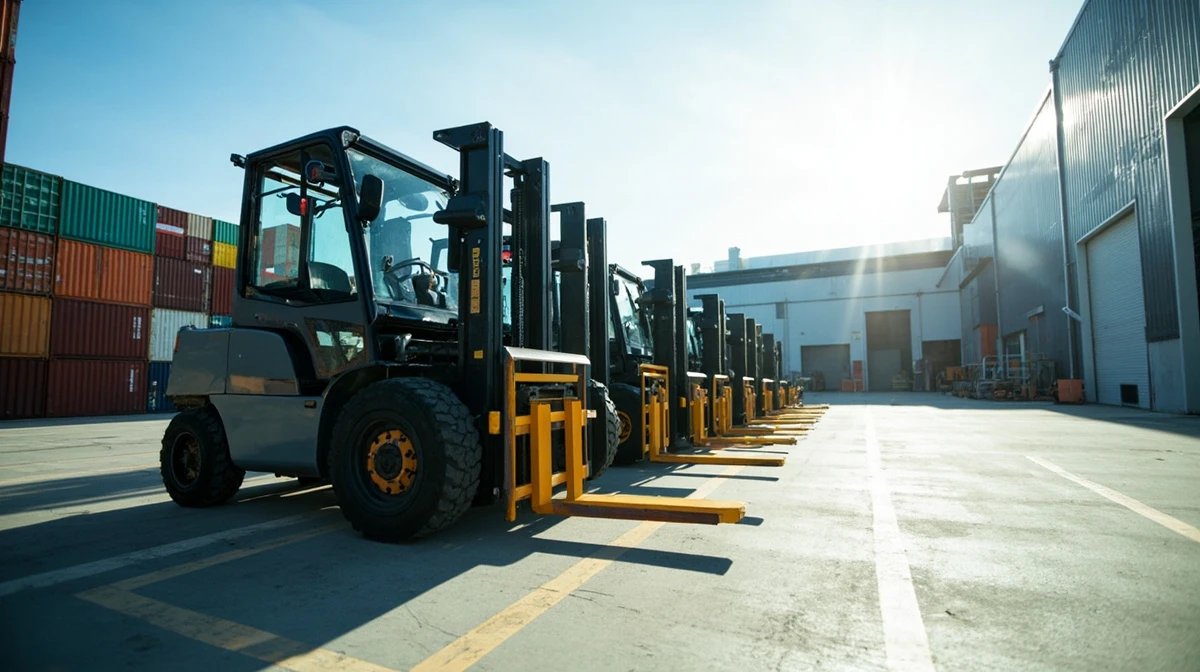
Stand Up Reach Forklift vs Sit-Down Counterbalance: Matching Truck to Aisle
The single most useful filter is aisle width. If your racking is already installed and the working aisle is tight, a stand up reach forklift is usually the only practical electric option. If you have wide aisles and heavy loads at low lift heights, a sit-down counterbalance truck — diesel, LPG or lithium-electric — will often be the more productive and lower-cost machine.
The table below compares the two families on the criteria that actually drive purchase decisions. Values are typical design ranges for the category; confirm exact figures against the specific model datasheet before you commit.
| Criteria | Stand Up Reach Forklift | Sit-Down Counterbalance |
|---|---|---|
| Operator position | Standing compartment, facing mast | Seated, facing forward |
| Typical wheel configuration | Three-wheel (two drive, one steer) | Four-wheel or three-wheel |
| Power source | Battery (lithium or lead-acid) | Diesel, LPG, or lithium-electric |
| Best fit | Narrow aisles, high racking, put-away and picking | Wide aisles, outdoor yards, heavy loads |
| Turning radius | Shorter; designed for confined aisles | Longer; needs more open floor |
| Load handling | Reach mechanism extends forks to the rack | Forks travel with the truck |
| Indoor air quality | Zero local emissions | Diesel/LPG require ventilation |
For operations that need both indoor narrow-aisle work and outdoor yard handling, the answer is usually a mixed fleet rather than one compromise truck. Impetus builds both sides of that fleet: the forklift and equipment catalog covers lithium-electric counterbalance trucks and electric reach trucks, alongside diesel, LPG and off-road models.
Where Stand Up Electric Forklifts Pay Off — and Where They Don't
Stand-up trucks are not a universal upgrade. They are a specialist tool, and they reward operations with specific characteristics.
Strong fit
- Distribution centres with racking above roughly 6 m where the operator needs a clear line of sight to the beam.
- Facilities where aisle width is fixed and cannot be widened without re-racking.
- Cold stores and food-grade warehouses where diesel or LPG exhaust is not acceptable.
- High-frequency put-away and case picking, where the operator dismounts many times per shift.
Weak fit
- Outdoor yards and unpaved surfaces — stand-up trucks are indoor machines.
- Very heavy loads at long load centres, where a counterbalance truck's counterweight is the safer answer.
- Operations with no battery charging infrastructure and no plan to install it.
Rule of thumb: choose the truck around the aisle and the rack, then size the capacity. Buying capacity you cannot use in a tight aisle is wasted capital.
Specifying a Stand Up Forklift: Capacity, Lift Height and Battery
Once the aisle decision is made, the specification narrows quickly. Work through these in order.
- Rated capacity at load centre. Capacity is always quoted at a stated load centre. A truck rated for a given load at a short load centre will handle less as the load centre grows. Check the derating curve, not just the headline number.
- Lift height and mast type. Match the mast to your top beam level plus clearance. Two-stage and three-stage masts trade free lift against collapsed height, which matters if you pass under mezzanines or doorways.
- Battery and charging. Lithium packs allow opportunity charging during breaks, which suits multi-shift operations. Lead-acid needs a dedicated charge room and cooling time. Choose based on shift pattern, not purchase price alone.
- Attachments and fork dimensions. Fork length, spread and any attachment change the effective capacity. Confirm the attachment's own weight is deducted from the rated load.
- Operator environment. For multi-shift use, look at compartment ergonomics, floor cushioning and control layout — these drive throughput more than any single spec sheet figure.
If your loads are heavier than a reach truck can safely handle, step up to a lithium-electric counterbalance model. Impetus offers the FB series from the FB15 at 1,500 kg through the FB50 at 5,000 kg and up to the FB100 at 10,000 kg, all with 3,000 mm lift as standard on the listed configurations. For very high-capacity electric work, the FB100 covers the 10-tonne class.
What Drives Stand Up Forklift Cost
Stand up forklift cost is not a single number — it is the sum of the truck, the battery, the charger and the infrastructure around them. Buyers who compare only the truck price usually underestimate the total.
- Truck configuration. Lift height, mast stages, fork length and attachments all move the price.
- Battery chemistry. Lithium packs carry a higher upfront cost than lead-acid but typically charge faster and need less floor space.
- Charging infrastructure. Chargers, cabling and any charge-room ventilation or fire compliance add to the project.
- Fleet size and duty cycle. One truck per shift versus two trucks running staggered shifts changes both capital and operating cost.
- Service and spares. Parts availability and local service coverage affect lifetime cost more than the invoice price.
For a realistic budget, ask for a landed-cost quotation that includes the truck, battery, charger and delivery — not a bare unit price. Impetus exports to more than 150 countries and can quote a complete package; start with the contact form and include your aisle width, lift height and load details.
Buying Checklist Before You Order
Take these to your supplier meeting. A vendor who can answer all of them is a vendor worth shortlisting.
- Measured aisle width at the narrowest point, not the nominal rack spacing.
- Top beam height and the heaviest load at its actual load centre.
- Shift pattern and whether opportunity charging is required.
- Floor condition and any ramps or dock levelers the truck must cross.
- Local service coverage and spare-parts lead time.
- Whether the truck will be used indoors only, or also on the apron.
If you are also weighing other categories — diesel for the yard, LPG for mixed indoor/outdoor work, or off-road for construction sites — the product categories page groups them so you can compare within one fleet plan.
Frequently Asked Questions
What is a stand up forklift used for?
A stand up forklift is used mainly for narrow-aisle work inside warehouses: putting away and retrieving pallets in high racking, case picking and truck loading where manoeuvrability matters more than raw capacity. Because it is battery-powered, it is also the natural choice for cold stores and food-grade facilities where exhaust emissions are not acceptable.
Is a stand up forklift better than a sit-down forklift?
Neither is universally better. A stand up reach forklift wins when aisle width is tight and lift heights are high, because its shorter wheelbase and standing operator position improve turning and visibility. A sit-down counterbalance truck wins on wide aisles, outdoor surfaces and heavy loads, where its counterweight and choice of diesel, LPG or electric power give it an advantage.
How much does a stand up forklift cost?
Stand up forklift cost depends on lift height, mast configuration, battery chemistry, attachments and whether charging infrastructure is included. Because a stand-up electric forklift is battery-only, the battery and charger are part of the project cost, not optional extras. The reliable way to budget is to request a landed-cost quotation covering the truck, battery, charger and delivery, based on your measured aisle width and load data.
Next Step
If you are specifying a stand up forklift for a new aisle layout or replacing an ageing reach truck, send us your aisle width, top beam height and heaviest load at its load centre. Impetus will match the configuration to your application and quote the complete package — truck, battery, charger and delivery — so you can compare on total cost rather than sticker price. Request a quotation from Impetus and put the numbers side by side before you commit capital.