
Reach Stacker Guide: Container Handling, Cost & Selection
A practical reach stacker guide: how container reach stackers work, lifting capacity, reach stacker cost vs Kalmar, and how to choose the right machine.
A reach stacker is a mobile container-handling vehicle built around a telescopic boom and a top-lifting spreader. Instead of lifting a box straight up like a forklift, it reaches out over the first row of containers, picks the box from above, and retracts the boom to carry it. That single design decision is why reach stackers dominate container yards, rail terminals and inland depots where space is tight and the container mix changes every shift.
This guide explains how a container reach stacker actually works, what determines lifting capacity, how reach stacker cost is structured, and how to compare a reach container stacker against a Kalmar reach stacker or a heavy forklift before you commit capital.
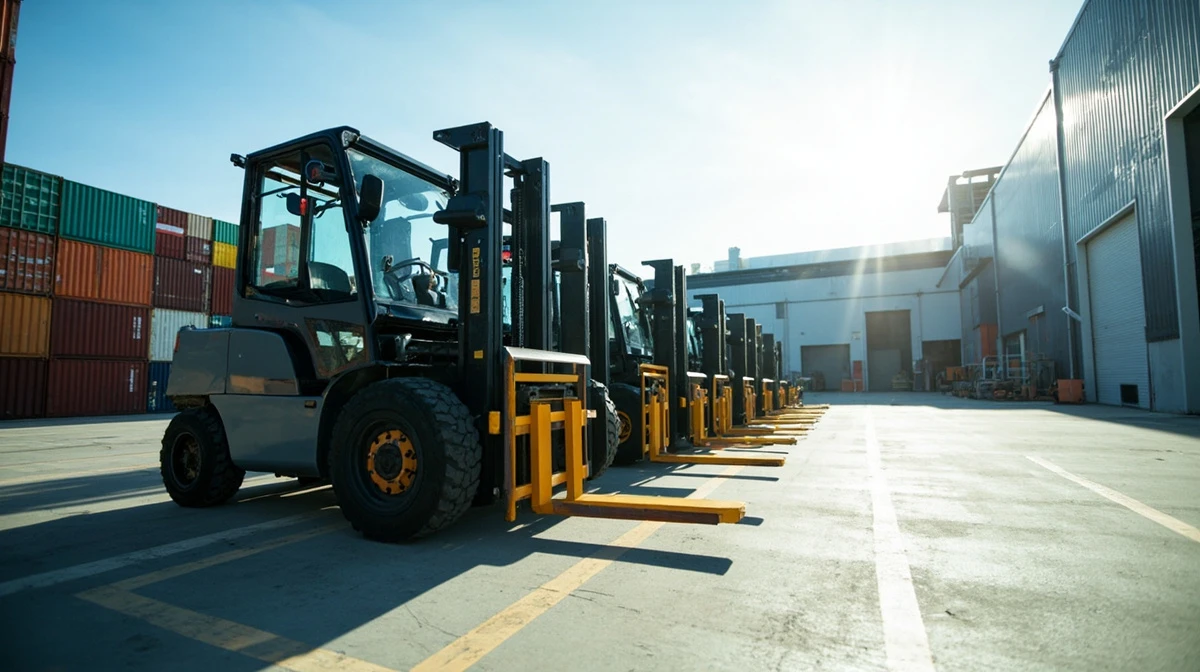
What a Reach Stacker Does That a Forklift Cannot
A conventional forklift lifts a load directly in front of the mast. To place a 40 ft container on the second row, the machine has to approach the stack head-on — which means the aisle must be wide enough for the whole truck plus the load. A reach stacker breaks that constraint. The boom extends forward, the spreader locks onto the container's top corner castings, and the machine retracts the load back over its own counterweight before travelling.
The practical results in a working yard:
- Narrower aisles. The machine picks from above rather than pushing a mast into the stack, so rows can sit closer together.
- Higher stacking. Container reach stackers are typically specified to stack several high in the first row, with capacity tapering as the boom extends.
- Faster turnarounds. One operator, one machine, no crane or chassis required for a short repositioning move.
- Mixed-fleet flexibility. The same machine handles 20 ft, 40 ft and 45 ft boxes with a spreader change, plus general cargo with a hook or clamp attachment.
That flexibility is the reason the category keeps growing even where dedicated container handlers exist. A reach stacker is not the cheapest way to move one box type at one fixed height — it is the cheapest way to move many box types at unpredictable heights.
How Lifting Capacity Is Actually Rated
Buyers often compare machines on a single headline number. That number is misleading. Reach stacker capacity is a curve, not a figure, and it depends on three variables at once: load weight, load centre, and boom extension.
When a container is lifted on the first row close to the machine, the load centre is short and the machine can use most of its rated capacity. Move to the second row and the boom extends; the load centre grows, and the safe lifting capacity drops. This is why a spec sheet will quote different capacities for the first, second and third row. A machine rated for a heavy first-row lift may only be able to handle a lighter box at the same height two rows out.
Three rules follow from this:
- Specify by your worst-case lift, not your average one. If your heaviest recurring move is a loaded 40 ft box on the second row, that is the number that matters.
- Check the load centre, not just the tonnage. Two machines with the same nominal rating can behave very differently once the boom is extended.
- Leave margin for attachment weight. A spreader, rotator or clamp consumes part of the rated capacity before the container is even attached.
Reach Stacker vs Forklift vs Reach Truck
These three categories get confused constantly, partly because the names overlap. They solve different problems.
| Machine | Typical role | Load type | Where it wins |
|---|---|---|---|
| Reach stacker | Container handling, stacking and short transport | ISO containers, heavy project cargo | Ports, rail terminals, container depots |
| Heavy diesel forklift | Palletised and breakbulk lifting | Pallets, coils, timber, machinery | Warehouses, yards, industrial sites |
| Reach truck | High-rack pallet handling indoors | Pallets on racking | Narrow-aisle warehouses |
The naming trap is real: a warehouse "reach truck" and a port "reach stacker" share almost nothing except the word reach. If your load is a pallet going into a rack, you want a reach truck. If your load is a steel box going onto a stack, you want a reach stacker.
For operations that need both container handling and general lifting, a mixed fleet often makes more sense than one oversized machine. Impetus builds both sides of that fleet — see the full forklift & equipment catalog for diesel and electric trucks from 1.5 to 12 tonnes, including the FD100 and FD120C for heavy breakbulk work.
What Drives Reach Stacker Cost
Reach stacker cost is not a single market price. It is the sum of configuration choices, and two machines with the same lifting rating can differ substantially in price depending on how they are built. The main cost drivers:
- Boom and structure. Longer reach and higher stacking require heavier booms and more counterweight — more steel, more cost.
- Spreader type. A fixed telescopic spreader costs less than a rotating or side-shifting unit that can handle 20 ft and 40 ft without repositioning the machine.
- Drivetrain and emissions. Engine tier, transmission and axle specification vary by market and add cost.
- Cab and controls. Raised, sliding or tilting cabs, camera systems and load-moment indicators all add to the invoice.
- Customisation. Cold-climate packages, dust protection, special paint and bespoke attachments push a machine well beyond a standard build.
This is also why a Kalmar reach stacker price and a reach stacker cost from an Asian manufacturer are not directly comparable line items. Brand, dealer network, spare parts logistics and lead time are part of what you are buying. A Kalmar reach stacker carries a premium for its established service footprint; a machine from a reach stacker manufacturer company in China competes on configuration flexibility, lead time and landed cost.
When comparing quotes, normalise them first: same spreader, same boom length, same engine tier, same warranty terms. Only then does the price difference mean anything.
How to Choose a Reach Stacker Manufacturer
The machine is only half the purchase. The other half is who supports it for the next decade. When shortlisting reach stacker manufacturers, ask for evidence rather than brochures:
- Reference sites in your region. Machines working in comparable climate and duty cycles tell you more than a spec sheet.
- Spare parts availability. Ask for a parts list with lead times for the boom, spreader, hydraulics and drivetrain.
- Service documentation. Maintenance intervals, torque specs and diagnostic procedures should be supplied in your language.
- Configuration honesty. A good manufacturer will tell you when a smaller machine will not do the job, rather than overselling capacity.
- Export experience. Shipping, customs documentation and pre-delivery inspection matter as much as the build quality.
Xiamen Impetus Industrial has been manufacturing and exporting lifting equipment for over 20 years to more than 150 countries. Our core range covers diesel, lithium electric and LPG forklifts, off-road trucks and warehouse equipment — the support fleet that runs alongside container handling operations. Browse the full product categories to see what fits your yard, or read more technical breakdowns in our news & guides section.
Frequently Asked Questions
What is the difference between a reach stacker and a container handler?
A reach stacker uses a telescopic boom and spreader to reach across stacks, giving it flexibility across container sizes and yard layouts. A dedicated container handler is usually built for a narrower, fixed duty — often empty-container handling at high volume. The reach stacker trades some specialisation for versatility.
How much does a reach stacker cost?
Pricing depends on boom length, spreader type, engine tier, cab specification and customisation. A standard configuration sits at the lower end; a heavily customised machine with a rotating spreader and cold-climate package sits well above it. Request a configured quote rather than comparing headline figures, because two machines with the same lifting rating can differ significantly in price.
Can a reach stacker replace a forklift in my yard?
Only if your loads are predominantly containers or heavy project cargo. For palletised goods, breakbulk and mixed general freight, a heavy diesel forklift such as the FD100 or FD120C is more efficient and far cheaper to run. Most container yards operate both: a reach stacker for boxes, forklifts for everything else.
Next Step
If you are specifying container handling or the support fleet around it, send us your load weights, stacking heights and yard layout. Impetus will recommend a configuration that matches your worst-case lift rather than your average one — and quote it with the same spreader, boom and engine specification you are comparing elsewhere. Contact Impetus for a quote and we will respond with a configured proposal and lead time.